
Poached
Fowl play. What happens when laying hens stop laying.

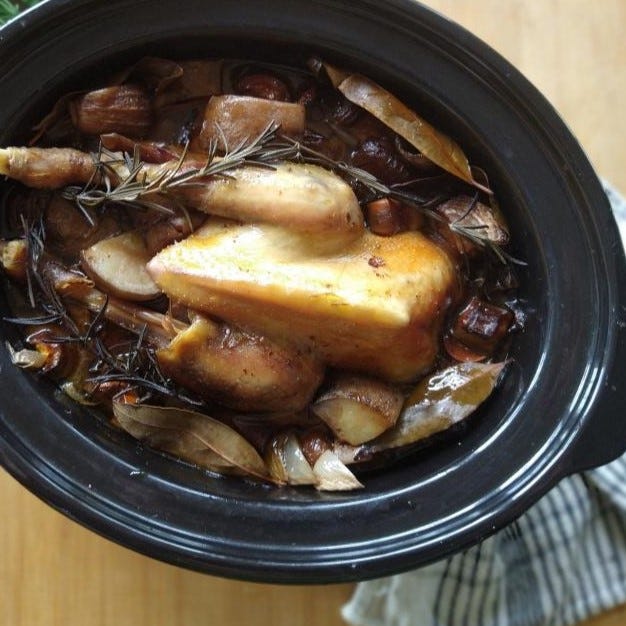
I have a clear childhood memory of being sent down the road to the kosher butcher to buy a boiling fowl (never a chicken) to make soup with. Making patterns on the sawdust covered floor with my shoes whilst waiting in the queue, trying to hold my breath because I never liked the smell. Back home, the bird would be cleaned with a microscopic, forensic frenzy, watching my mum burning any remaining feathers or stubble with matches to singe them away. I was most fascinated by the buried treasure, the unlaid line of eggs inside the birds body. In Yiddish they’re known, somewhat unimaginatively as eyerlekh, EYE-ER-LECH ‘little eggs’. The bird would be laid to rest in a large pan of water, with aromatics added; onion, celery, carrot, clove, bay leaf, and gently cooked for many hours, leaving a fugue of chicken fumes in the air. The eggs would be added last, poached to a gentle sunshine yellow firmness.
More recently I asked myself why I can never find a boiling chicken, a fowl, an ex layer anymore, why they’re so hard to find. On farmers’ market stalls they will appear now and again. To answer my own question a laying hen will only be dispatched once its useful life is over. Some farmers I spoke with will aim to re-home their ex layers, killing them as a last resort.
Jeremy Lee in Cooking (2022) celebrates “auld school” ingredients and includes references to boiling fowls, particularly in the context of traditional Scottish broths and “chicken of a certain age.”
Ben Mervis in The British Cookbook (2022), mentions the boiling fowl as the traditional (and preferred) bird for Cock-a-Leekie soup, noting that while they are now hard to find, they provide a depth of flavor modern broilers cannot match.
Julius Roberts, in The Farm Table (2023), discusses the ethics of farming and the culinary value of older birds that have finished their laying life, advocating for the slow-simmering methods used for boiling fowls.
And, naturally, as I was finishing this piece, The Guardian’s quarterly food magazine features Angela Hartnett sharing a recipe for poached chicken; hers though, is a table bird.
Jane Grigson, Marguerite Patten and Elizabeth David are likely to be the last generation of writers who could assume a reader would be able to buy a boiling fowl at their local butchers without a special order, although Farmhouse Kitchen 1987 mentions boiling fowl in a recipe. Jane Grigson, for her Hindle Wakes recipe in English Food (1974) directs the reader to a roasting chicken, capon or ‘a really good boiling fowl.’
Felicity Cloake has tested modern recipes against the “boiling fowl” standards of the mid-20th century, lamenting that they have become a “rare beast” in the 21st century.
Dorothy Hartley in Food in England devotes a chapter to poultry, including a little lecture on why chickens, and cockerels are seasonal. Unless you keep poultry, or shop at farmers’ markets it’s likely you’ve not considered this; we see eggs and chickens all year round. Vestiges of seasonality remain in phrases such as spring chicken. A fowl of uncertain age she says, is better boiled.
Some countries and cultures value table birds and ex layers equally; they’re both important. Do we dismiss the ex layer, because it needs long, slow cooking first? Or because adding a chicken to water is out of favour? Adding bones to water to make stock is very much IN favour. It’s not hard to find a chicken carcass at a farmers’ market. Buy one if you see it. It will reward you with a flavoursome stock and very often lots of pickings on the bones.
Search online and you may find the phrase ‘hard chicken’ or ‘spent hen’ to describe a boiling fowl, an ex layer. Mostly, on kosher and halal websites. I found them in butchers and fishmongers, never with a welfare standard mentioned, listed for around £4.50-£6.00.
I want a chicken I can trust to have had a good life and the only thing I know if I buy kosher or halal, unless it’s specified that the bird is organic, is how the bird has died, not how it has lived. There are a few organic halal farms, but sadly not enough.
Laying hens, the ones that provide us with eggs, and chickens for eating are two different beasts. Birds for the table are raised quickly. An ex layer, compared with a standard table bird is a lot older; I’ve written about the life of poultry here. Tamarisk Farm say theirs live 18 times longer than hen raised to go straight from field to the table after only 6 weeks.
They look different; you won’t find the plump Dolly Parton style breasts in an ex layer; they will be longer, skinnier, rangier, larger. The bones will be harder, stronger if they’ve had a good outdoor life.
Campaign in World Farming note that;
‘‘At about 60-70 weeks of age, egg production will slow down; this is called ‘end of lay’. The birds are referred to as ‘spent’ hens. At approximately 72 weeks old the birds are removed (called depopulation) and transported to the slaughterhouse. In many countries there are fewer abattoirs with facilities for slaughtering laying hens and birds often travel much further to a slaughterhouse than meat chickens (broilers).’’
Rupert Langmead of Rookery Farm eggs told me; ‘‘nowadays we end up re-homing over 50% of our old hens through chicken rescue charities, so they end up in peoples gardens. If we can’t get them re-homed, then they do have to be sent for slaughter, and there are not many companies left that operate in that sector. We certainly could not do any slaughtering or processing ourselves. The halal and kosher butchers are pretty much the only places that sell old hens now.’’
Trying to trace one of Ruperts hens is an impossible task. Rupert uses a company called A.D Harvey; ‘‘a big operation and basically almost do us a favour by still coming to us. Our hens will end up alongside all the other old hens they collect from much much bigger farms, so it will be impossible for you to be able trace our old hens through them to whoever they sell to.’’
James Evans of Pastures Poultry processes their end of lay hens and sells them for around £5 at Walthamstow farmers’ market from time to time. It’s not scheduled as their egg business is pretty small.
In 1993 with the decline of butcher shops, AD Harvey moved from broiler processing to solely end of lay hens. By 2000 their new factory was capable of processing 15,000 birds a day.
All the birds they process are sold into wholesalers across the UK. Mostly as fresh whole birds. Wings and legs are sold through their wholesalers, fillet going for further processing, ending up in pizza toppings, sandwich fillings, pies and soups.
Around 70% of their product is free range although they do not market it or sell it as such, Tom Harvey telling me; ‘‘It is not something our customers are concerned about or have ever requested.’’
Everything they process is intended for human consumption and is sold throughout the UK including to many ethnic communities. Tom Harvey thinks that their products ‘‘suit a style of cooking that is not practiced by many Western cultures in today’s fast moving modern world.’’' He told me;
‘‘Several years back we were involved with a TV programme, Friday night feast hosted by Jamie Oliver and Jimmy Docherty. We were hoping it would open many people’s eyes to this undervalued poultry product. They featured our hens and did a taste test up against standard chicken and free-range chicken both considerably younger less tasty products. They waxed lyrical about the boiling fowl / free range hen. Promised to start serving it in Jamies’ restaurant chain. All empty promises and nothing came of any of it. We concluded it was all just about creating good TV, and they didn’t actual believe in promoting a more sustainable, higher welfare, longer life poultry product.’’
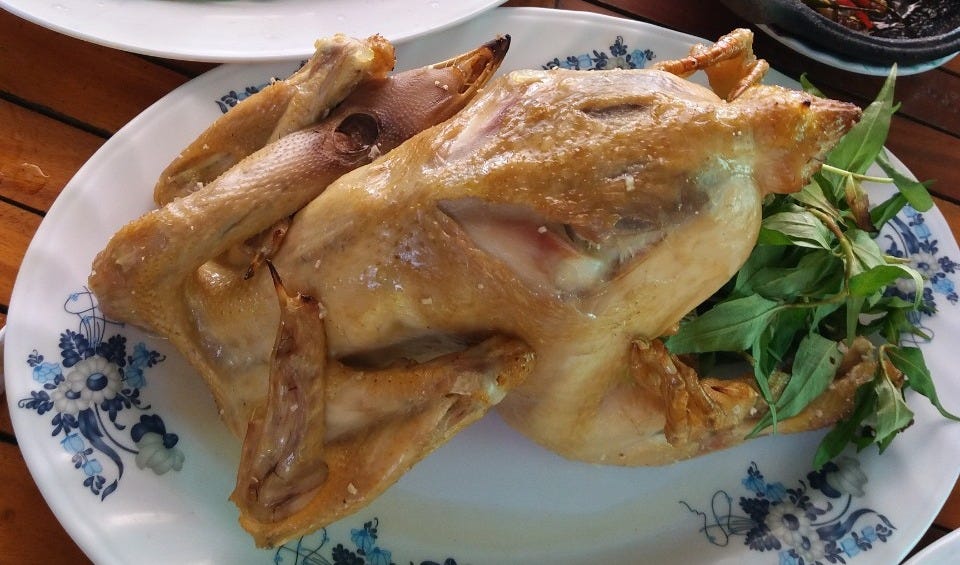
‘‘You will also find ours and similar types of products in many African, Chinese, and Nepalese shops as well. The UK is importing a great deal of these products in from other countries including Holland, Poland, Spain, Ukraine and even from Brazil. There is a lot of demand for this high quality yet very cheap meat. Traditional butchers’ shops can source it, and its available from all major meat markets in the biggest UK cities.’’
Tom thinks that ‘‘ the market is steadily growing. I’m not sure it will feature heavily on a traditional British menu or table. Unless we change how we cook. It seems people want to cook meals in as little time as possible. Hen meat does not suit this as you know.’’
How did we get from poaching, stealing, to poaching, to cook gently in water?1
We are comfortable with poached eggs, but a poached chicken is a rare fowl these days. But, as Claudia Roden told me; ‘‘a boiling fowl is so much better for soup. ‘‘
Catherine Phipps agrees; and with a boiling fowl that could take all night to tenderise, a pressure cooker is your friend. Like me she wishes they were easier to get hold of.
Her advice; ‘‘Pressure cooking is very good at tenderising the toughest and stringiest meat. For a normal chicken you would cover with cold water with all the aromatics, bring up to high pressure and immediately remove from the heat. By the time it has dropped pressure it is perfectly cooked. With a boiling fowl, cover in cold water, up to pressure, cook for 5 mins, natural release, it will still be piping hot and you end up with a lively broth too. It is better to leave it until the pot is cool and then if you want to eat hot, gently reheat - again back up to pressure and natural release. Salting is key! Regardless of how I cook chicken I think overnight salting helps enormously.’’
I began this article remembering being offered boiled chicken...a boiling fowl, the flesh stretched taut, slightly yellow, chewy, blobs of undissolved wobbly fat edging the dish like amoeba clouds, tough chewy piece of chicken floating in a watery grave. Possibly from someone who took the words ‘boiling fowl’ a little too literally. An old bird needs low, slow careful cooking.
Moist, tender chicken in a golden broth with a handful of cooked rice or barley, chunks of lime green leeks and comforting carrots. A sprinkling of parsley. It’s a joy. And a way to stretch a chicken over four meals. To eat the broth first or keep it for stock, then eat the meat, with plenty of leftovers.
Bring it alive with salsa verde’s punchy flavours; sharp, citrusy, tangy, herby. Or use poached chicken for any of your favourite chicken dishes.
Where to buy; it’s not easy tracking down high welfare boiling fowl but try these;
Tamarisk Farm (Dorset): One of the few farms that explicitly lists “Organic Stewing Hen” as a standalone product. They are a certified organic farm that celebrates the “depth of flavour” of birds that have lived up to 18 times longer than a standard meat chicken.
Springfield Organics: Known for their high-welfare poultry, they frequently stock boiling fowls. If they aren’t listed on the main page, they are often available as part of their “Soup or Stock Packs.”
After publishing this piece I exchanged comments with Sue Quinn who wrote an excellent article on the subject of boiling fowl in 2019. One of the farmers she interviewed, Ben Jackson from Fluffetts Farm no longer sells them. He told me that COVID put a stop to their end of lay boiler hen project. They lost all their London restaurant customers and the network of chefs who were trying to put the project together.
‘‘the momentum on that concept has never built up again although perhaps with this new era of energy price escalation and the potential knock on effects on food supply interest might reignite.’’
He also raised an excellent point;
‘‘Looking back and forward I think the key lies in the local abattoir question as one of the key hurdles was route from farm via slaughterhouse to restaurant. My understanding is in the pre-Common market days poultry keepers would gradually farm their old hens out to the local butcher keeping the chain short and local.’’
As already mentioned in my piece, there are very few abattoirs who kill ex laying hens and, the number of small abattoirs is sadly decreasing.
If you do manage to source a high welfare boiling fowl do please let me know!
Thank you for reading and being with me today. Please consider supporting my writing by becoming a paid subscriber, or buy me a coffee.
fascinating - I do remember trying my best to source a boiling fowl when I wrote that (when online butchery was in its infancy as I recall). Thanks for the sources - as with mutton and lard, it's frustrating that it's so hard to find higher-welfare options here!
I am inspired to revisit, Cheryl. I think I’ll order a boiling fowl - or two - and do a pressure cooking post…